What is the Map element, and why use it?
The Map element drops an interactive map straight onto your page — the same kind you can drag, zoom, and explore, just like Google Maps. You pin a location, and visitors can see exactly where it is.
Why use it? Because "we're at 123 Main Street" is far less useful than an actual map showing the spot. A map removes friction — visitors instantly understand where something is without copying an address into another app. Common uses:
- Businesses showing their office or store location so customers can find them.
- Event organizers marking the venue, parking, and nearby hotels.
- Travel websites highlighting destinations and points of interest.
- Real estate pages letting buyers see exactly where a property sits.
Quick reminder on where elements live: Every FlexiFunnels page follows the Section → Row → Element structure. The Map drops into a Row like any other element.
Quick Video:
Step 1: Add the Map element to your page
- Open your editor and go to the Components section.
- Select Elements.
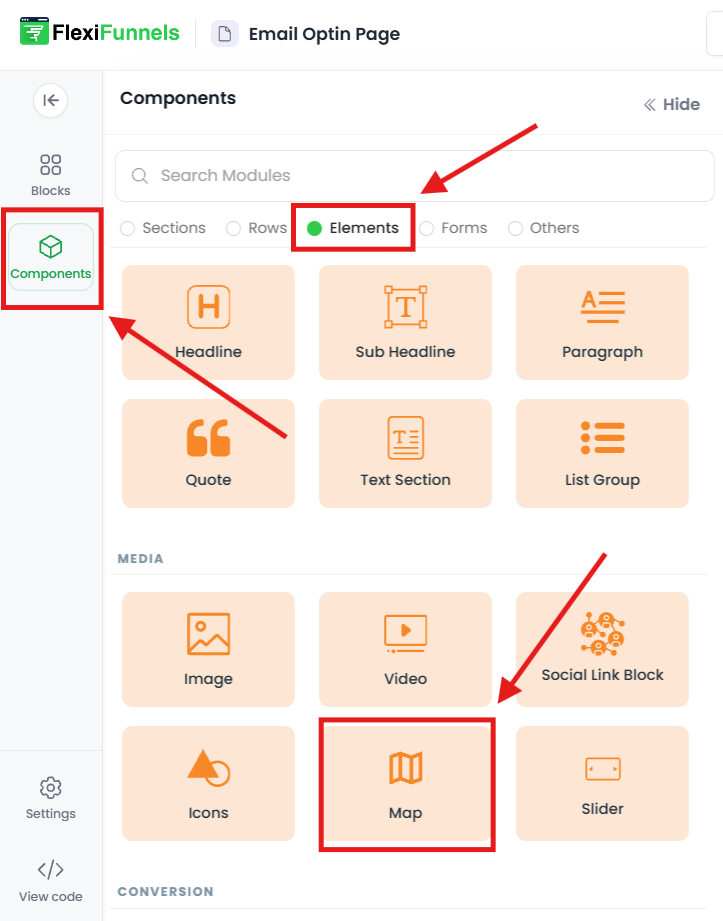
Find the Map element and drag it into your editor workspace.

Step 2: Open the Map settings
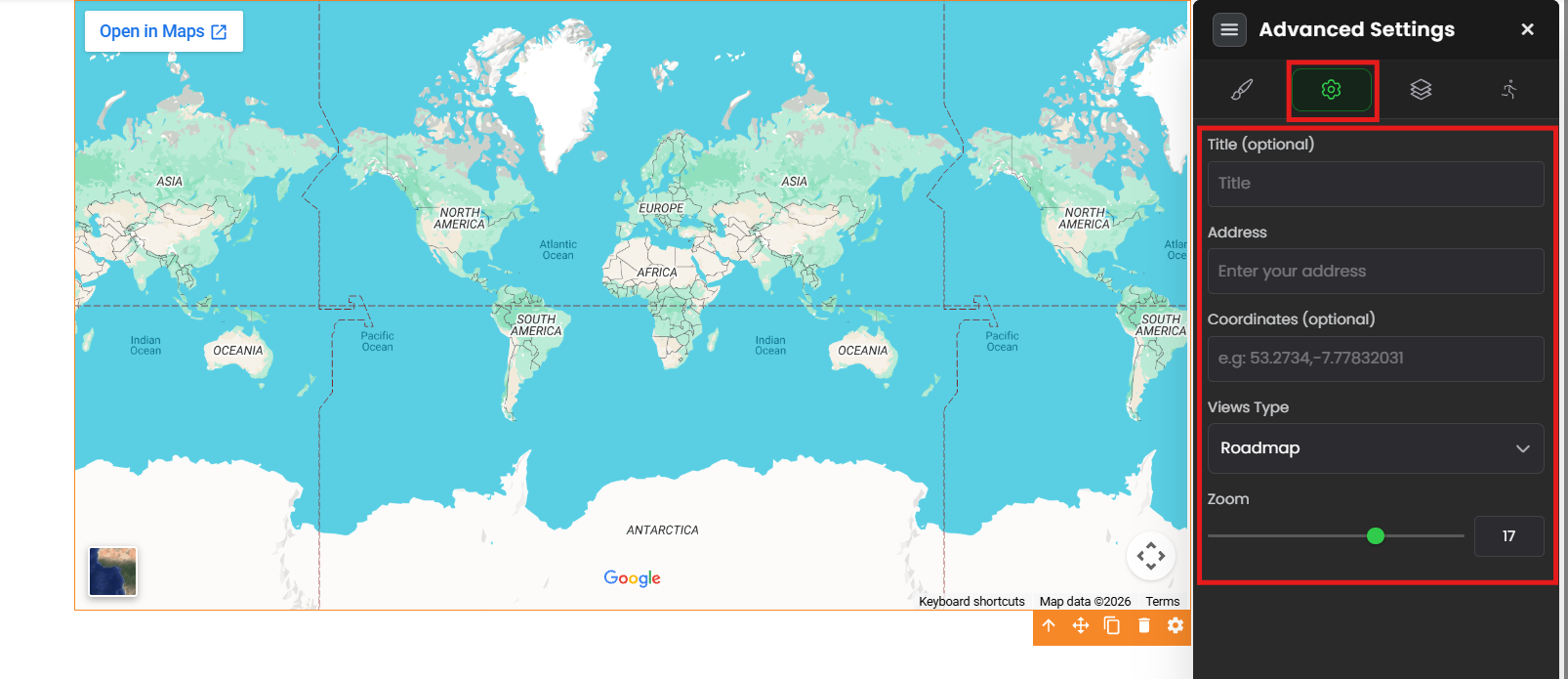
Click the Map element to open its settings. A pop-up appears — click into the Advanced Settings tab. This is where you'll set the location and choose how the map looks.
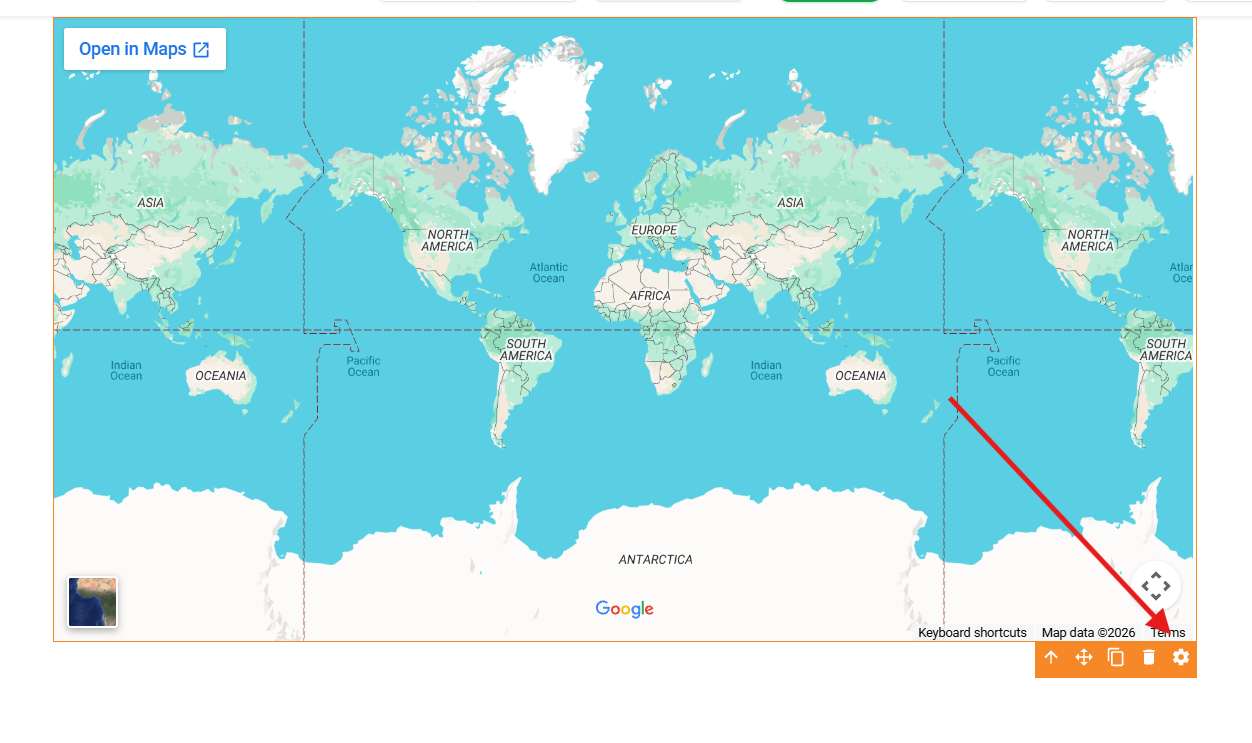
Step 3: Tell the map where to point
You have two ways to set the location. Pick whichever is easier for you — you only need one.
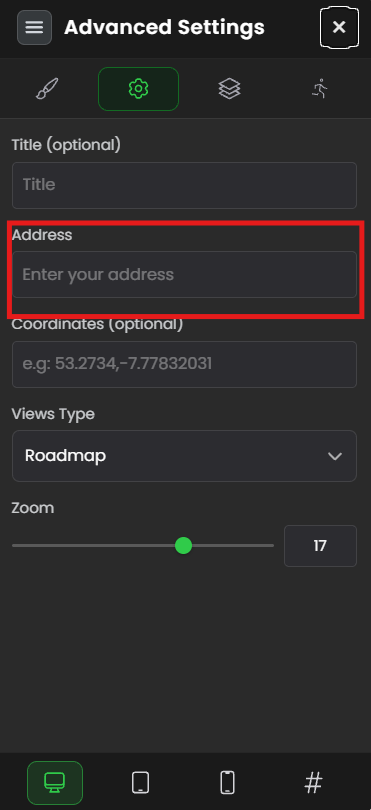
Option A — Address (the simple way)
Just type the location name or street address into the Address field (for example, "FlexiFunnels Office" or "221B Baker Street, London"). The map finds it for you. This is the easiest method and works for most people.
Option B — Coordinates (the precise way)
Coordinates are the exact map numbers for a spot — useful when an address is vague or when you want pinpoint accuracy.
How to get them from Google Maps:
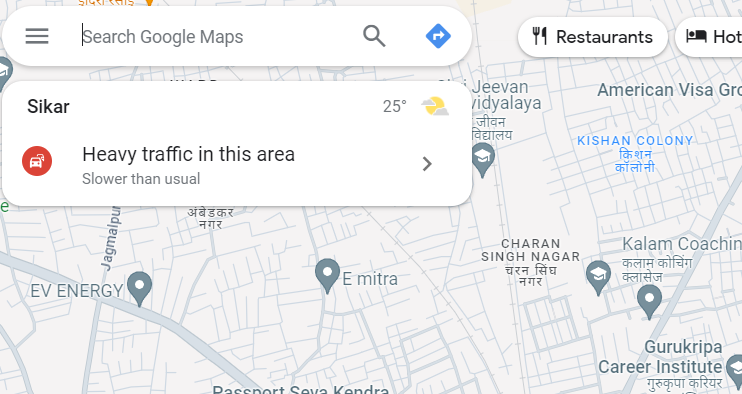
- Open Google Maps.
- Search for your location.
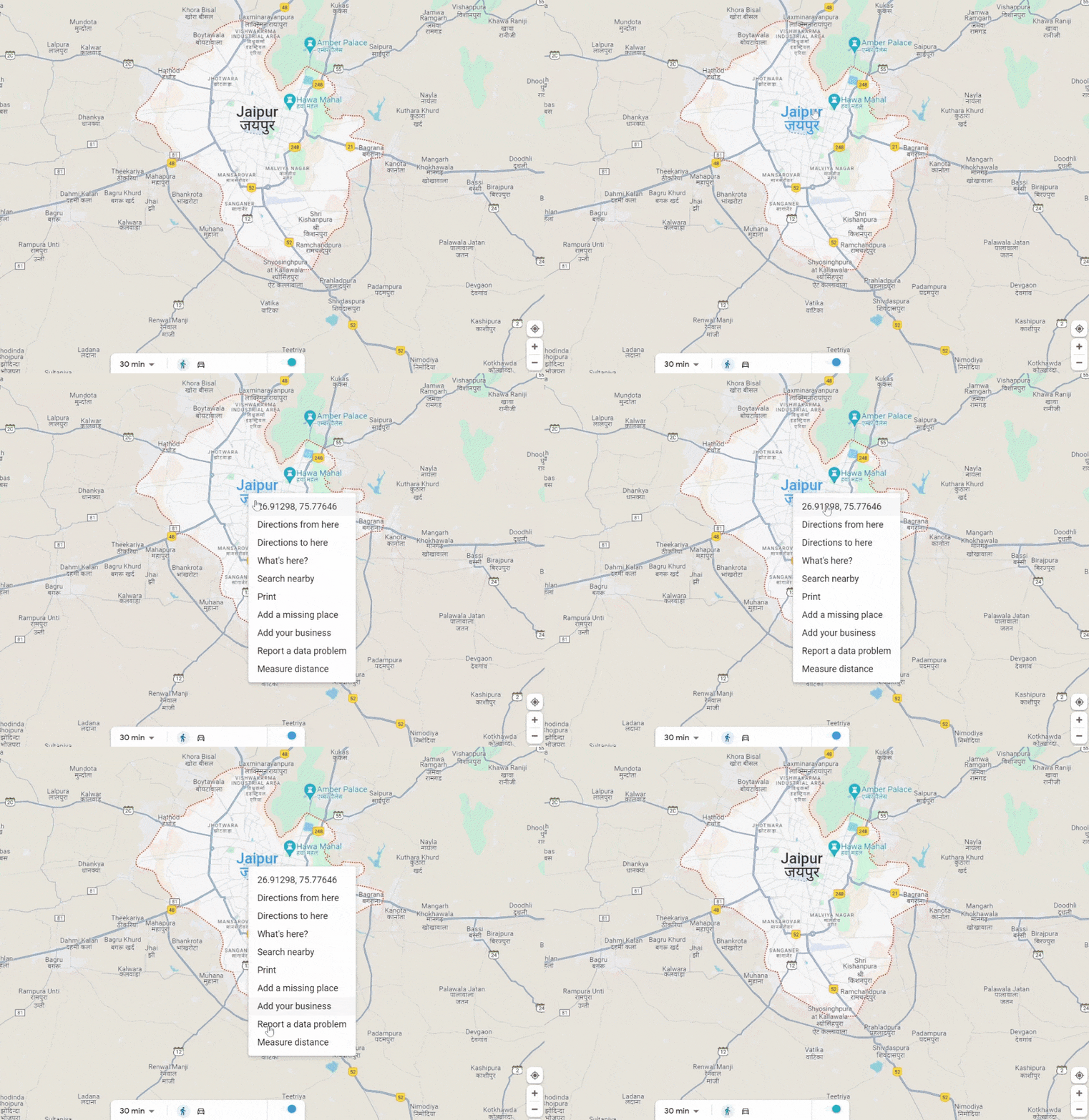
- Right-click on the exact spot on the map.
- The coordinates appear at the top of the menu as two numbers (like
26.9124, 75.7873). Click them to copy. - Paste those numbers into the Coordinates field in your Map element.
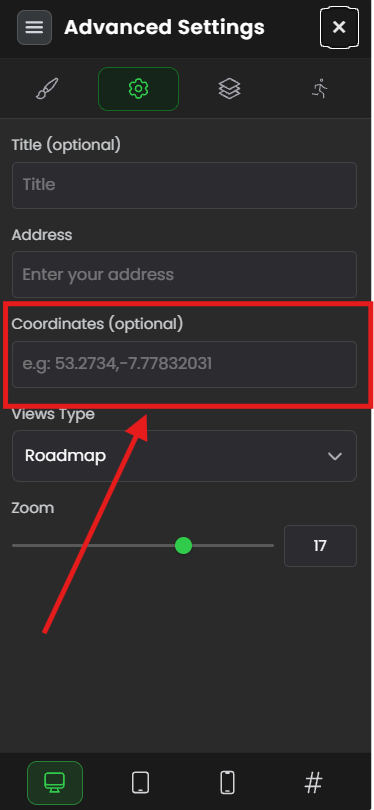
What are "coordinates"? They're two numbers — latitude and longitude — that pin an exact point anywhere on Earth. Think of them as the map's version of a precise home address that never changes, even if the building's name does.
Additional features available in the Advanced Settings include:
Step 4: Choose how the map looks
Still in Advanced Settings, you have two more controls:
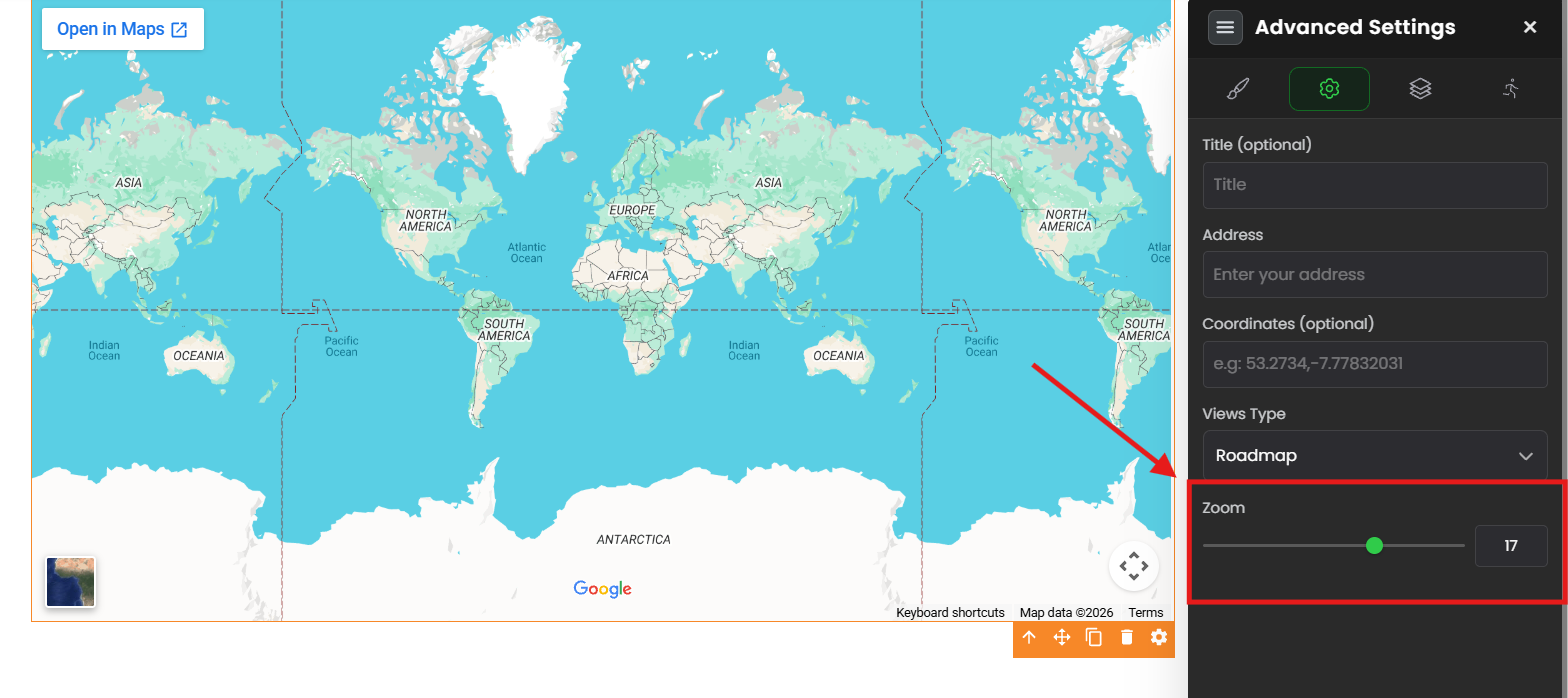
- Map Views (View Types) — Switch between Roadmap (the standard street-map look) and Satellite (real aerial photos from above).
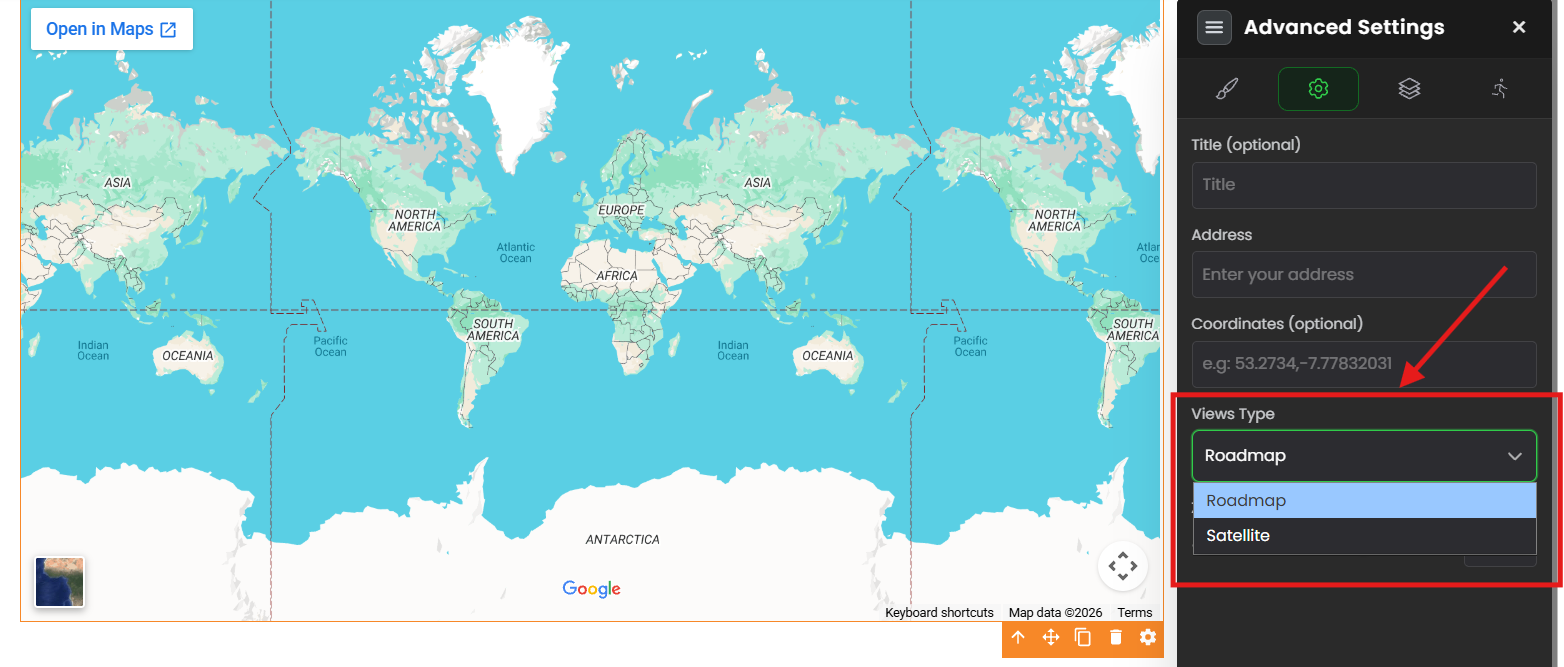
- Zoom Settings — Set how close-up the map starts. Zoom in to focus tightly on one building; zoom out to show the surrounding area, neighborhood, or city.
Use Cases of Map Elements:
1.) Businesses often use Map elements to display their office locations, making it convenient for customers to find them.
2.) Event organizers can use Map elements to mark important locations such as event venues, parking areas, and nearby accommodations.
3.) For Travel websites, you can use the Map elements. Users can explore different travel destinations and viewpoints of interest and plan their itineraries with the help of interactive maps.
4.) In real estate lead generation pages, you can also use Map Element so prospective buyers can easily visualize the geographic location of properties.
When you're happy, save and publish. ? Your map is live.
Common situations & quick fixes
Check these before contacting support.
"My map shows the wrong location." → Most often this is an address that's too vague (e.g., a business name that exists in many cities). For accuracy, switch to Coordinates — copy the exact numbers from Google Maps (Step 3, Option B) and paste them in.
"My address isn't being found at all." → Double-check the spelling and add more detail — include the city and country, not just a street name. If it still won't resolve, use Coordinates instead, which always works.
"I pasted coordinates but the pin is in the wrong place." → The two numbers must stay in the right order (latitude first, then longitude) and keep their format exactly as copied from Google Maps. Re-copy them by right-clicking the exact spot, and paste without adding spaces or changing the punctuation.
"My map is zoomed too far in or out." → Adjust the Zoom Settings in Advanced Settings until the view frames your location the way you want.
"The map looks blank or grey on my live page." → Save and check the published page, not just the editor. Then reload the live page and clear your browser cache — maps sometimes need a moment to load fully.
"I want an aerial photo instead of a street map (or vice versa)." → Toggle Map Views between Roadmap and Satellite.
"The map looks cramped on mobile." → Switch to mobile view in the editor and adjust the zoom so the key location is still visible on a narrow screen.
Need more help?
If your map still isn't behaving after the steps above, submit a ticket and include:
- The page URL where the map appears
- The address or coordinates you entered
- What location it should show vs. what it's actually showing
- A screenshot of your Advanced Settings
Was this article helpful?
That’s Great!
Thank you for your feedback
Sorry! We couldn't be helpful
Thank you for your feedback
Feedback sent
We appreciate your effort and will try to fix the article