Conditional fields is a fancy term for a simple idea: show extra form fields only when a customer selects your bump offer. Think of it like a restaurant menu — you only ask about dietary restrictions after someone orders the meal, not before.
In practice: a customer arrives at checkout and sees just three fields (Name, Email, Phone). If they click "Yes, add the bump," then additional fields appear (Address, Company, Shipping Preference, etc.). If they click "No," those extra fields never appear. Cleaner checkout experience = higher conversion rates.
Why This Matters
The problem: Long forms with 15+ fields scare people away. Every extra field you ask for increases drop-off.
The solution: Show only the fields that are essential for everyone (Name, Email), then reveal extra fields only for customers who select the bump.
The result: bump buyers complete the checkout because they're motivated and expecting the extra form; non-bump buyers aren't overwhelmed by unnecessary fields.
? Real numbers: studies show that removing even 2–3 unused form fields can increase conversions by 5–10%.
How It Works — The Core Concept
Scenario: You're selling a $47 course (main product) with a $17 physical workbook (bump).
Without conditional fields:
- Everyone sees 8 form fields: Name, Email, Phone, Address, City, State, Zip, Company.
- Most course-only buyers think: "Why is it asking for my address? Sketchy."
- Some abandon checkout.
With conditional fields:
- Everyone sees 3 fields: Name, Email, Phone.
- If they click the bump ("Add the Workbook"): Address, City, State, Zip appear.
- If they skip the bump: those fields never appear.
- Course-only buyers feel the form respects their time.
- Workbook buyers understand why address is needed.
Field Categories
Always Visible (Basic Information):
- Name
- Phone (optional)
These show for every customer, every time, no exceptions.
Conditional (Bump-Only):
- Address, City, State, Zip (for physical delivery)
- Shipping method
- Gift message
- Company name
- Any other information relevant only to the bump
These appear only if the customer clicks "Yes" on the bump offer.
Step-by-Step: Enable Conditional Fields
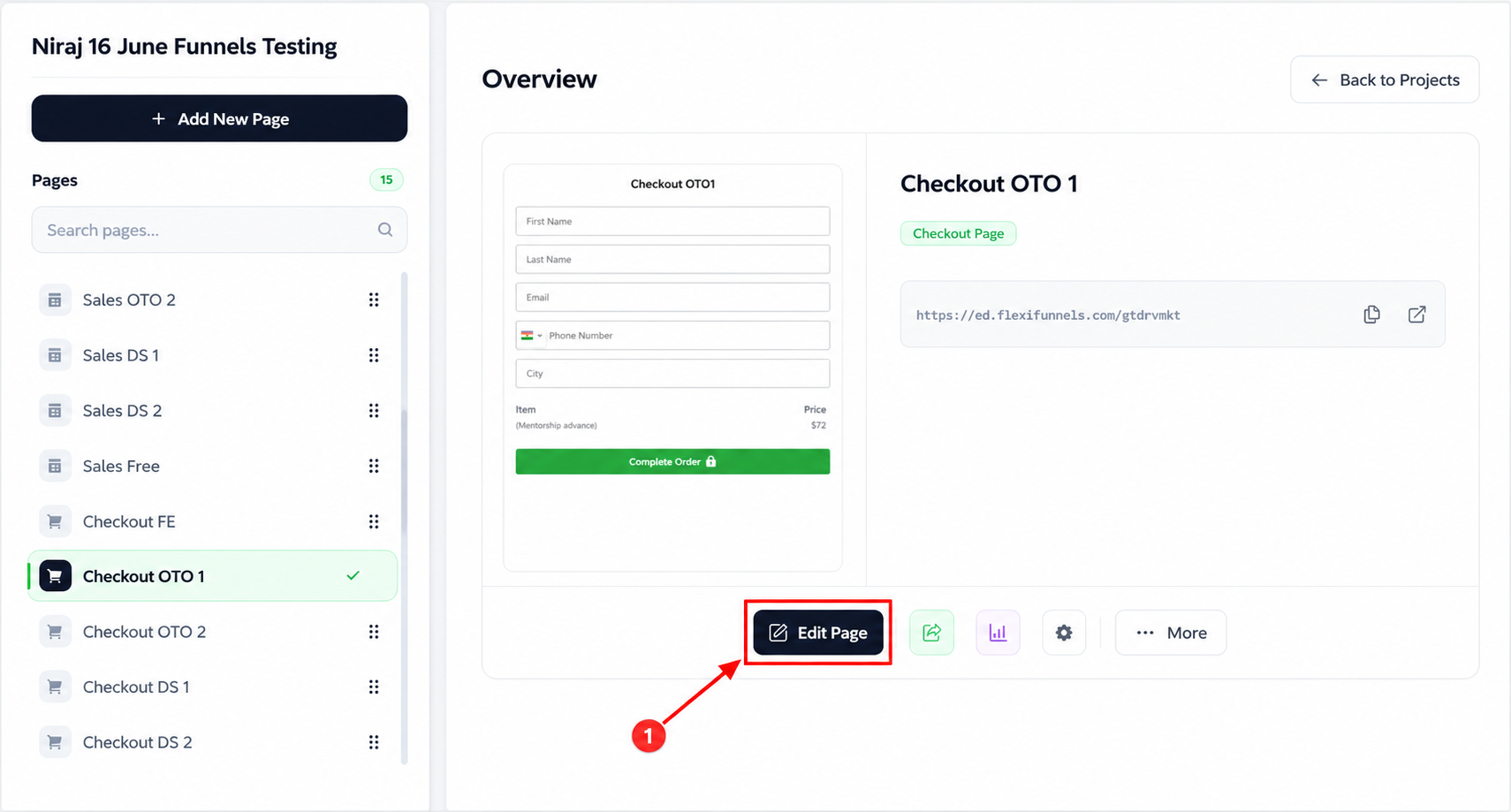
Step 1 — Open Your Checkout Page Editor
Log into FlexiFunnels, open the checkout page you want to modify, and click into the editor.
Step 2 — Add or Open Your Order Form
Navigate to where your order form (checkout form) sits on the page.
- If you don't have one, click "+" and add an Order Form element.
- If you already have one, click on it to select it.

? What is an order form? It's the form customers fill out at checkout — where they enter Name, Email, etc. It's distinct from the bump offer display above it.
Step 3 — Open Advanced Settings
Click on the order form to select it, then look for the gear ⚙️ icon or "Advanced Settings" option.

Step 4 — Enable "Disable Form Fields"
In Advanced Settings, find the checkbox labeled "Disable Form Fields" and check it.
⚠️ Note the confusing name: "Disable Form Fields" actually means "Enable the ability to hide fields conditionally." It sounds backward, but what it's doing is saying: "Disable (hide) the extra fields by default, then enable them only when the bump is selected."

When you check this box:
- Name, Email, Phone fields stay always visible.
- All other fields become hidden by default.
- Those hidden fields automatically appear when the customer clicks "Yes" on the bump offer.
- If the customer clicks "No" to the bump, the extra fields stay hidden.
5.) Publish the Page:
After configuring the settings, publish your page to make the changes live.

⚠️ Don't forget this step. The conditional fields only work on the published checkout page, not the editor preview.
Testing It Works
Before announcing the checkout to customers, test it:
- Go to your live checkout page (published URL).
- Do NOT click the bump. Fill out just Name, Email, Phone. Do you see only those three fields?
- Refresh the page. Click the bump offer. Do the extra fields (Address, etc.) now appear?
- Proceed through checkout with the bump selected and verify the form feels natural.
If extra fields don't appear when you select the bump, the conditional setup isn't active. See the Troubleshooting section below.
Real-World Use Cases
Use Case 1: Physical Product Bump
- Main product: Digital course ($97)
- Bump: Physical workbook + flashcards ($27)
- Conditional fields: Address, City, State, Zip, Shipping method
- Why: Digital course buyers don't need shipping info; workbook buyers do.
Use Case 2: Add-On Service
- Main product: Software tool (one-time $149)
- Bump: One-on-one onboarding call ($49)
- Conditional fields: Preferred call time, time zone, company name
- Why: Most customers don't need the call; those who select it need scheduling details.
Use Case 3: Membership with Tier Bump
- Main product: Basic membership ($29/month)
- Bump: Premium tier upgrade (+$49/month)
- Conditional fields: Industry, company size, use case
- Why: Helps you segment premium users for better support.
Best Practices
- Keep the core form short. Name, Email, Phone — nothing else visible by default. Even requiring 4 fields has a measurable drop-off impact.
- Group conditional fields logically. All shipping fields together, all preferences together.
- Make conditional fields required only for bump buyers. If a field appears, assume the customer expects to fill it.
- Test with a real bump offer. Don't enable conditional fields without actually creating a bump. The fields won't appear without a bump triggering them.
- Combine with other strategies. Conditional fields work best alongside a compelling bump headline and image. See How to Create a Bump Product (Bump Offer).
Common Situations & Quick Fixes
"I enabled 'Disable Form Fields' but extra fields still appear for everyone."
- Did you publish the page after checking the box? (Changes don't go live until you publish.)
- Are you testing on the live page, not the editor preview?
- Does your checkout page actually have a bump offer created? Conditional fields only work if a bump is present to trigger them.
"The extra fields don't appear when I select the bump."
- Hard refresh the live page (Ctrl + F5 / Cmd + Shift + R).
- In browser Developer Tools, clear LocalStorage for the page.
- Confirm the bump offer is created and enabled on this product. See How to Create a Bump Product.
- Are the extra fields actually in the order form? If you added fields but didn't add them to the form, they won't appear. Add missing fields first.
"Some fields appear even without the bump being selected."
The conditional setup might not be fully applied. Try:
- Re-check the "Disable Form Fields" checkbox (uncheck, then check again).
- Re-publish the page.
- Clear your browser cache and test again.
"I want different fields hidden for different products."
Each checkout page has one order form. If you have multiple products on different checkout pages, set up conditional fields separately for each checkout page.
"The form looks cramped when conditional fields appear."
Adjust the form's width or spacing in the order form settings. The conditional fields appear dynamically, so the form needs room for them. See Form Element Settings for styling options.
How It Impacts Conversions
Expected outcome: customers who see fewer fields are less likely to abandon. Here's what users typically see:
- Without conditional fields: "Ugh, 8 form fields. This feels like a lot. [Closes tab]"
- With conditional fields: "Oh, just Name, Email, Phone — easy. [Completes] ...wait, there's a bump? For $17? Sure. [New fields appear, customer fills Address, completes purchase]"
The reduction in visual clutter before the bump selection often increases main product conversions. The conditional reveal of shipping fields after the bump selection normalizes the extra information collection.
Was this article helpful?
That’s Great!
Thank you for your feedback
Sorry! We couldn't be helpful
Thank you for your feedback
Feedback sent
We appreciate your effort and will try to fix the article